


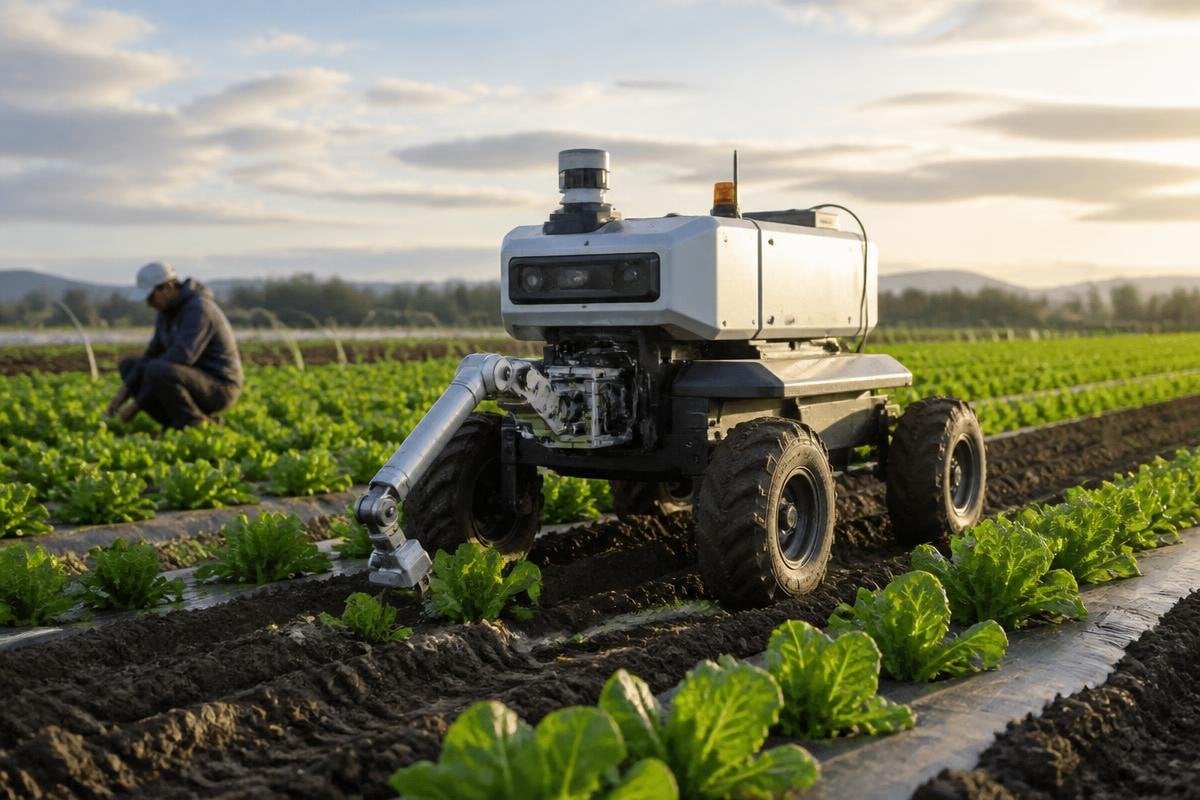
One farm robot can spot a weed, place a seed, or pick ripe fruit without putting a person in every row. That could help farms handle labor gaps and reduce waste, but the machine must work in mud, dust, rain, and uneven ground.
Quick read:
- Robots can target weeds, inspect crops, and move loads around farms.
- Cameras, GPS, LiDAR, and robotic arms each solve a different task.
- The hard test is cost, uptime, and safe work around people.
Where farm robots can help
The easiest jobs to automate are repeated tasks with a clear path and a visible result. A small field robot can drive between crop rows, use cameras to spot weeds, and apply treatment to selected plants instead of covering the whole field.
That approach can cut the amount of chemical used, though the result depends on camera quality, crop spacing, and weather. A robot that misses weeds still leaves the farmer with the same work later.
Harvesting is harder. A picking robot must find fruit among leaves, judge ripeness, reach the stem, and remove the fruit without bruising it. Each step needs careful sensing and control, especially when wind moves the branches.
Robots can also handle work around the crop rather than inside it. Autonomous tractors can follow planned routes, while mobile platforms can carry crates, tools, or harvested produce between field and storage. Those jobs have fewer delicate movements, so farms can test them with less risk to the crop.
The parts that make this possible
Several systems usually work together in a farm robot. Cameras collect images of plants and soil. Global positioning system receivers help the robot follow a route, while LiDAR measures nearby objects with laser pulses.
Wheel motors, steering, and software then turn that information into movement. The robot needs a way to stop when a person, animal, vehicle, or unexpected obstacle enters its path. That means physical emergency stops, safe speed limits, and controls that keep working when the network connection fails.
The task also decides the robot’s shape. A wheeled machine may suit a flat vegetable field. A tracked base can spread its weight over soft ground. A robotic arm needs enough reach and force for the crop, yet it must move slowly enough to avoid damage.
The move from trials to working farms is where weather, soil, and crop damage test the claims. Farm robotics reporting from Robot24.com can point you to named machines, field tests, and reported limits before the discussion turns to what the field demands.
The limits are in the field
Farm work changes from one hour to the next. Soil can become too soft for wheels. Dust can cover lenses. Rain can reduce camera quality. A route that worked yesterday may fail after a storm or a change in planting pattern.
Power creates another limit. A battery robot may need regular charging, battery swaps, or a return trip to a base station. Every pause cuts the hours available for field work. A diesel tractor can carry fuel for long runs, so a farm robot has to earn its place through lower labor demand, lower input use, or better crop handling.
Support matters too. Someone on the farm needs to clean sensors, replace a wheel motor, check software settings, and recover the robot after a fault. If the maker sends a technician from far away, a small fault can stop work during a short harvest window.
The strongest opposing view is that farms can get more from better tractors, tools, and farm planning than from a new robot. That will be true for many farms, especially where fields are large, crops are uniform, and labor is available.
A practical buying checklist
Before paying for a farm robot, check these points:
- Name the task: measure whether the robot will weed, pick, inspect, carry, or drive.
- Check the crop: confirm that the sensors and end effector suit the plant, fruit, soil, and row spacing.
- Price the full system: include the base station, charging gear, training, repairs, software, and transport.
- Test bad conditions: run it in dust, wet soil, low light, slopes, and crowded work areas.
- Plan recovery: ask who retrieves a stuck robot and how long replacement parts take to arrive.
A farm robot earns its place when it can repeat one job safely through the conditions that stop people and machines today. I’d back focused systems for weeding, inspection, and transport before buying a general-purpose robot for the whole farm.
The next useful proof will come from full growing seasons: how many hours the robot works, how often a person must intervene, and whether the crop yield pays for the machine.